8 Ways to Fund a STEM Program at Your School
Eight funding channels for classroom STEM — Title IV-A, Title I, grants, PTA funds, and crowdfunding — for teachers who assume there is no budget.
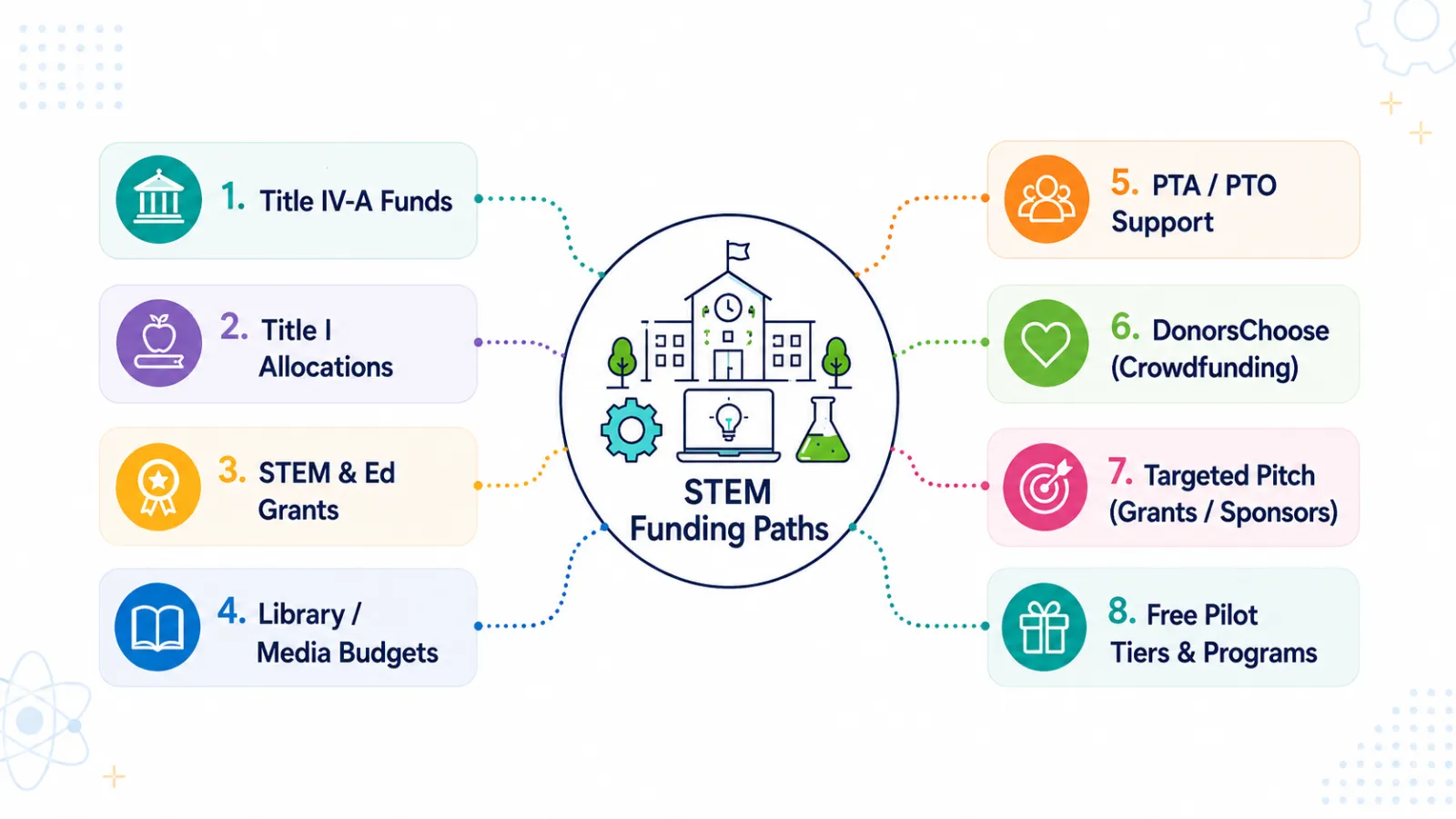
When a STEM tool doesn’t fit in the classroom supply budget, it’s easy to assume the school simply doesn’t have the money. Often, the budget just isn’t where you’re looking. Federal formula funds, grants, library budgets, and parent groups all fund classroom technology in ways that don’t show up if you’re only thinking about the supply closet line item. Here are eight channels worth checking before you assume the answer is no.
-
Look into Title IV-A funding. Title IV-A supports well-rounded education, safe and healthy students, and the effective use of technology. STEM is specifically included as an allowable well-rounded education activity, including hands-on STEM learning. If your district receives Title IV-A funds, ask your federal programs office whether STEM funding is available for your school.
-
Check whether Title I applies to your school. If your school qualifies as high-poverty under Title I, ask your principal or Title I coordinator whether classroom technology fits under an existing allocation. It’s broader than Title IV-A and not technology-specific, but it’s worth asking whether there’s room in the current allocation for this kind of purchase.
-
Look for STEM or enrichment grants aimed at your grade level. These range widely in size. Search your state’s Department of Education site, local education foundations, and platforms like DonorsChoose for STEM-specific opportunities. Even smaller grants are worth applying for — they can free up other budget for a bigger ask, and applying for a few over time adds up.
-
Ask about library or media center budgets. Digital tools sometimes fall under a different budget bucket than physical supplies — it’s worth asking your library or media specialist whether they have discretionary funds that could apply to a classroom STEM tool.
-
Bring it to your PTA or PTO. Parent groups fund classroom technology more often than teachers realize, especially when the ask is specific and the impact is easy to picture: “this covers hands-on STEM for one grade level for a year,” not a vague request for “more technology.”
-
Try DonorsChoose or a similar crowdfunding platform. If your school doesn’t have available budget lines, crowdfunding puts the request directly in front of people who want to help — parents, local businesses, and people who just like funding classrooms.
-
Make the ask easy to say yes to. Whoever approves the funding — a principal, a department head, a PTA board — usually isn’t evaluating the tool itself. They’re evaluating whether it’s a safe, well-reasoned request. Come with a specific number, a specific use case (“this grade level, this unit, this semester”), and if you can, a sentence about the learning outcome it supports. Vague requests get vague answers; specific requests get decisions.
-
Start free while you wait. Plenty of STEM tools, Qweebi included, offer a free tier — so you can prove out the fit with your actual students before asking anyone for money. If it works, you walk into the funding conversation with real classroom results instead of a hypothetical pitch.
The bottom line
“No budget” often means “not this budget.” Between Title IV-A, Title I, grants, library budgets, PTA support, and crowdfunding, there are several channels worth asking about before you assume the funding isn’t there.
Ready to bring hands-on STEM to your classroom?
Try 2 Qweebi projects free and see how students design, build, test, and improve, without kits or supplies.